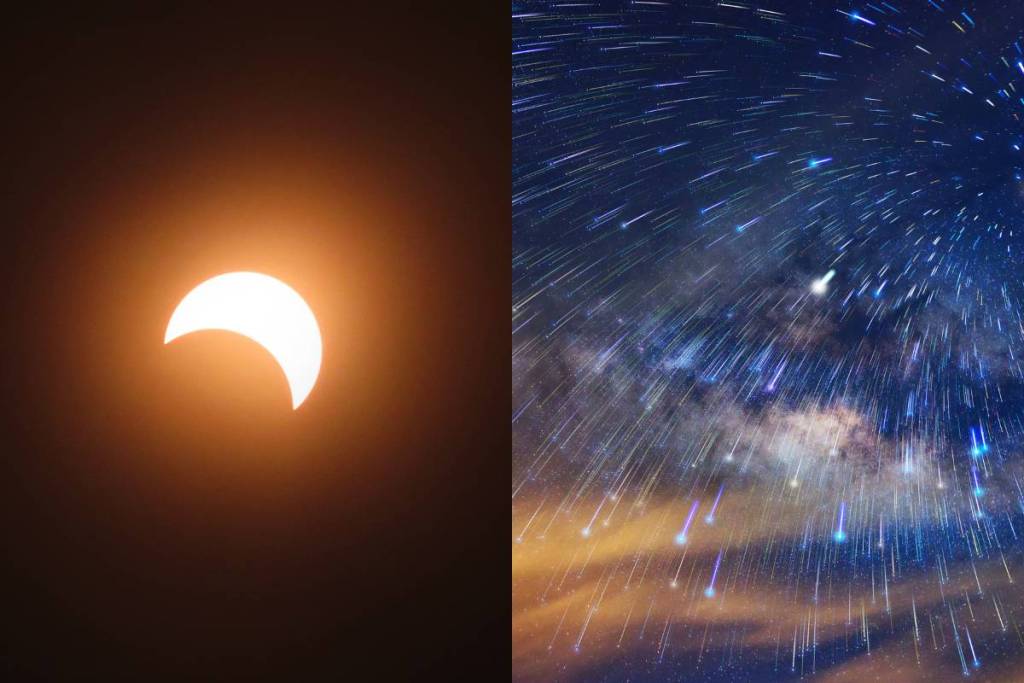

Philadelphia has a very good reason to look up on Wednesday, August 12. Over the course of about 24 hours, three different celestial events will unfold: a six-planet parade before sunrise, a partial solar eclipse in the afternoon, and the peak of the Perseid meteor shower overnight.
It is essentially an astronomical triple feature — and you don’t need to leave Philadelphia to catch at least part of it.
What can Philadelphia see before sunrise?
The celestial action begins before the Sun comes up with a six-planet parade.
About 30 to 60 minutes before sunrise, Saturn, Mars, Mercury, Jupiter, Uranus, and Neptune will be positioned across the morning sky. However, that doesn’t mean all six will be equally easy to see from Philly.
Saturn and Mars should be among the easier planets to spot. Mercury and Jupiter will sit low near the eastern horizon, making a clear, obstructed view especially important. Uranus and Neptune are much fainter and will require binoculars or a telescope.
For casual skywriters, the planetary lineup is more of a reason to get outside early than a guarantee that six bright planets will be obvious to the naked eye.
When can Philadelphia see the partial solar eclipse?
The main daytime event arrives Wednesday afternoon.
Philadelphia will experience a partial solar eclipse from 1:11 p.m. to 2:35 p.m., with maximum coverage at 1:53 p.m. At its peak, approximately 7% of the Sun will be covered by the Moon.
That’s considerably less dramatic than the total eclipse visible in parts of Greenland, Iceland, northern Russia, Spain, and Portugal. Nevertheless, it is still a chance to see the Moon pass across the Sun right here in Philly.
According to Nasa, viewers much use certified eclipse glasses or another proper solar filter when looking at the partially eclipsed Sun. Regular sunglasses are not sufficient.
How can you watch the eclipse if Philly weather doesn’t cooperate?
Clouds could always have the final say, but NASA has a backup plan.
NASA will offer livestream coverage of the eclipse beginning at 1:15 p.m. Eastern on Aug. 12. The broadcast will be available through NASA+, YouTube, Instagram, Facebook, Twitch, X, and Amazon Prime.
So even if Philadelphia’s skies are cloudy, you can still follow the eclipse online.
When is the best time to see the Perseid meteor shower?
The nighttime finale arrives after dark as the Perseid meteor shower reaches its peak overnight from Aug. 12 into Aug. 13.
The timing is especially favorable because the peak coincides with a new moon, meaning there will be little moonlight competing with the meteors.
For Philly-area viewers, getting away from the city’s light pollution will make the biggest difference. First, head somewhere with darker skies. Next, give your eyes about 20 to 30 minutes to adjust. Then, start watching after midnight when meteor activity is expected to be strongest.
The Perseids can produce spectacular bright meteors, but the number you’ll actually see depends on clouds and local viewing conditions.
Three celestial events, one very busy day for the sky. Philly, look up!